New Palestine, IN Cafe Shutters
Street privacy at standing height, daylight kept up top
Here's what to know before specifying this for your house. Room conditions, mount type and lift system all change the outcome, and the answers below explain how each one moves the decision.
- Service: Cafe Shutters for New Palestine homeowners
- Service area: New Palestine, IN and surrounding areas A restring, a new cord lock, a tilt mechanism or a dead motor battery gets handled far faster than a new order, because nothing has to be built. New custom work runs on the factory's two to five week clock.
- Insured and bonded
- Serving New Palestine, IN since 2008
Expert Cafe Shutters for New Palestine Homes
Cafe shutters cover the lower half of a window and leave the top open, and they were made for exactly the situation the 1838 plat produces. Those 163 pre-1940 houses around East Main, Mill and North Street have tall narrow openings with high head heights, sitting close to a sidewalk on a grid laid out in fifteen blocks. A full shutter closes the whole window and takes the daylight with it. A cafe shutter blocks the sightline from the street at standing height and leaves the upper glass clear, which on a tall opening is most of the light in the room.
The limitation is the obvious one and it should be said plainly: half the window is uncovered, at all times, forever. That means no light control at the top, no darkening, and no help with the low west sun that the true east west grid of the 1838 plat delivers above the panels. It also means the divider height is a permanent decision, because the shutter is built to it. Set it too low and you can be seen over the top from the walk. Set it too high and the room loses the light you bought the shutter to keep. We mark the line on the trim and have you stand in the room before we order.
Signs You Need Cafe Shutters
If you notice any of these in your New Palestine home, it is worth booking a measure. None of it is urgent, and none of it fixes itself either.
Existing panels stop at a random height
A bay window has never had anything on it
A deep sill holds plants you want visible
The top of the window is worth keeping
A front room faces a busy sidewalk
A dining room feels exposed from the street
The sill is too deep for panels to swing
Full-height blinds would waste a tall window
An older house needs a period-correct detail
There isn't enough depth for a full shutter frame
How New Palestine Window Treatments Handles Cafe Shutters
Every job follows the same five-step process. Transparent, thorough, and done right the first time.
Divide height decided at the window
Openings measured, out-of-square recorded
Trim and casing depth noted
Seated eye level checked in the room
Plan made for the glass above
Cafe Shutters in New Palestine
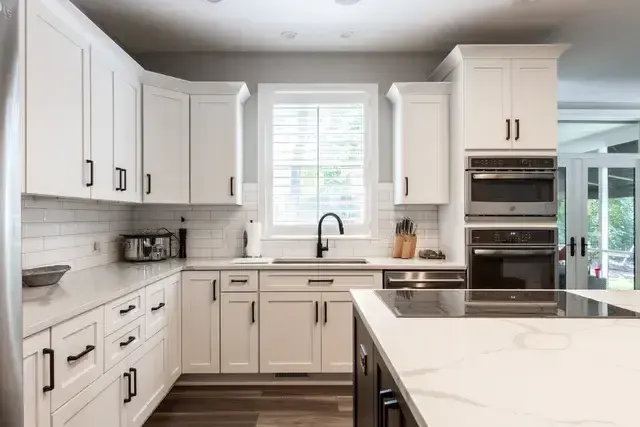
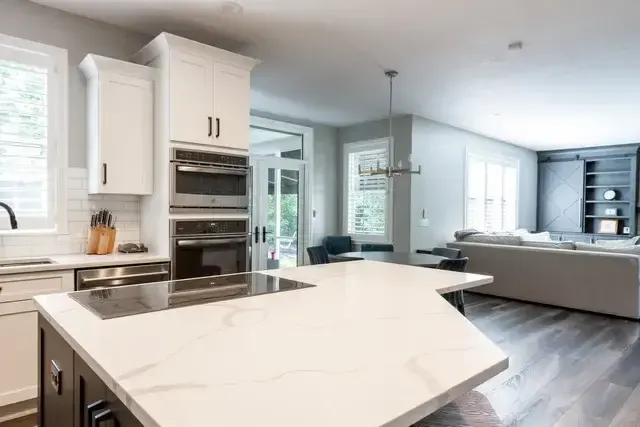
Photographs from real cafe shutters jobs completed by our crew in New Palestine and surrounding areas.
What Cafe Shutters Includes
Every New Palestine job is documented item by item. Here is what the crew covers.
The divide height decided at the window with you standing in the room and then sitting in it
Three widths and three heights taken across the lower part of the opening, plus a diagonal check for square
The horizontal bar across the middle of the opening located, since that's usually where the panels should stop
One divide height carried across every window in the room instead of being set opening by opening
The sightline from the sidewalk checked, because privacy at sitting height is the whole point of the product
Mounting depth read at the lower corners so panels clear handles, cranks and anything else inside the opening
Frame style chosen per opening: an L-frame inside, a Z-frame lapping the casing, or a hanging strip on the face
Whether the top of the panel gets a capping frame or is left open decided at the measure, since that edge is visible
Material specified per room, poly or composite where humidity swings and hardwood where the room stays conditioned
Louver size chosen against a short panel, where a large louver reads out of scale faster than it does full height
Panel count and swing direction drawn so nothing hits a faucet, a countertop or a window crank
A T-post drawn on wide openings so each panel stays a width that swings properly and stays flat
Divider rails left out unless the panel is unusually tall, since a cafe panel rarely needs one
Hinge style and finish chosen knowing the hardware sits at eye level for anyone sitting down
Paint or stain matched to the existing trim with a physical sample in the room, never off a screen
Whatever goes above the panels planned in the same visit, or the upper glass deliberately left bare
Written contract with scope, dates and total price, as IC 24-5-11 requires on residential work over $150
Frames shimmed plumb, louver tension set panel by panel, then caulk and touch-up run at the frame line
What Cafe Shutters Cost in New Palestine
Published national figures for interior shutters run roughly $175 to $800 per window. That's a national range for the category and it isn't a price for any opening in New Palestine. Cafe shutters land lower in that band than full-height panels, though not by as much as people assume. You're covering half the window, so there's less material. You are not doing half the work. The frame still gets built to the opening, the hinges still get hung, the finish still gets matched to your trim, and somebody still has to stand at the window and decide where the divide goes. Across Hancock County, the openings that cost most are wide ones needing a T-post and old ones that have settled well out of square.
How Cafe Shutters Differ by Product
Every product in this trade behaves differently in a room. Here is what that means for this work.
Poly and composite panels: An engineered core with a hard painted finish that ignores moisture. This is what goes over a kitchen sink and in a bathroom, because Indiana humidity moves hardwood and a moved panel stops closing against its neighbor.
Hardwood panels: Usually basswood, lighter for the same panel and able to carry a stain that shows grain. On a short cafe panel in a conditioned front room, stained hardwood against original trim is a look no painted composite gets close to.
2 1/2 inch louver: The right default on a half-height panel. A short panel only holds so many louvers, and going small keeps the proportion sane and gives you finer control over the angle you tilt them to.
3 1/2 inch louver: Worth using where the lower part of the window is unusually tall, or where full-height shutters elsewhere in the house already use this size and you want the rooms to agree with each other.
L-frame: A simple right angle sitting inside the opening, lapping the face of the trim slightly. It's the cleanest install when the opening has depth, and on a cafe it keeps the frame from drawing attention to the fact that it stops halfway up.
Z-frame: Adds a flange that covers the edge of the existing casing, which hides an opening that has settled and gives the installer somewhere to take up the difference. It's the usual answer in an older house, where nothing is quite plumb.
Hanging strip on the face: Hinges mount to a narrow strip fastened onto the face of the casing rather than a full frame. It's the lightest-looking option, it works where the opening has almost no depth, and it puts the panels proud of the trim.
Hidden tilt rod: The linkage moves into the stile so the louver face is uninterrupted. On a cafe panel that sits right at eye level for anyone at a table, losing the center rod makes a noticeable difference to how the window reads.
T-post on a wide opening: A fixed vertical post between panels so no single panel gets wide enough to sag or swing badly. It also gives the louvers something to close against in the middle, which is where a wide cafe otherwise leaks light and sightlines.
A shade above the panels: A roller, a Roman or a woven natural mounted above the cafe shutters covers the upper glass when you want it covered. This is how you keep the daylight most days and still kill a low sun that comes straight down the street.
Cafe Shutters FAQ
Questions we hear most often from New Palestine homeowners considering cafe shutters.
Cafe Shutters Across New Palestine
We measure and install in every one of these New Palestine neighborhoods. Each has its own page with the build eras, window conditions and mounting notes for that section.
- Cafe Shutters in The Original Town Plat
- Cafe Shutters in Cedar Creek and Cedar Cove
- Cafe Shutters in Bridgewood
- Cafe Shutters in Harting Farms
- Cafe Shutters in Willow Ridge
- Cafe Shutters in Centennial, Centennial Commons, Centennial Village and Centennial North
- Cafe Shutters in Boulder Creek
- Cafe Shutters in High Acres
- Cafe Shutters in Countryside and Homestead
- Cafe Shutters in Deer Run and the wildlife named streets
- Cafe Shutters in The Preserve
Other Window Treatment Services in New Palestine
New Palestine Window Treatments handles the full scope of window treatment work. Explore our other services below.
Faux Wood Blinds in New Palestine
Moisture proof slats for New Palestine wet rooms and wide openings
Learn more →Wood Blinds in New Palestine
Stained hardwood slats matched to real casing, not drywall returns
Learn more →Vertical Blinds in New Palestine
Vane coverage for the door walls in New Palestine's newest plans
Learn more →Schedule Your Free In-Home Measure in New Palestine
Reach Us Directly
Our team prioritizes scheduled measures and service calls, and books in-home measures during business hours.
Ready to Book Your Measure?
Call us to set up an in-home measure, or to ask about a treatment that has stopped working. We will talk it through on the phone first.