Office Window Treatments in New Palestine, IN
One facade standard, with reach ranges and openness decided early
A quick summary before the details: this is a made-to-order product, measured in the home and built to your numbers. The answers here explain what that means for pricing, timing and what happens if something fails.
- Service: Office Window Treatments for New Palestine homeowners
- Service area: New Palestine, IN and surrounding areas Realistic sequence: appointment for the measure, a written specification, then fabrication of two to five weeks, then install. None of it needs rushing, and pushing the factory is where mistakes on custom sizes come from.
- Insured and bonded
- Serving New Palestine, IN since 2008
Expert Office Window Treatments for New Palestine Homes
If you're specifying for office space in New Palestine, the pipeline is the 79-acre Town Center site and the tenant suites that come with it, plus the smaller commercial frontage along US 52 and Westside Drive. A town of 1,326 housing units doesn't generate a large office inventory, so most scopes here cover a single tenant or a handful of suites rather than a floor plate. That changes the work. You're specifying one product family across a facade that several tenants will fit out on different schedules, and the uniformity being protected is what the street sees rather than what any one occupant prefers.
Two specification decisions do most of the work. The first is reach, since operable controls in accessible spaces have to sit within the ADA reach ranges, so a wand or chain ending at seven feet fails the requirement no matter how well the shade performs. Motorized control with a wall switch at an accessible height is often cleaner than arguing about hardware length. The second is glare, which is an openness factor decision rather than a fabric color one. A 1 percent weave cuts the most and gives up the view. A 10 percent weave keeps the view and won't save a monitor on a west wall along US 52.
Signs You Need Office Window Treatments
If you notice any of these in your New Palestine home, it is worth booking a measure. None of it is urgent, and none of it fixes itself either.
Staff on the west side work with monitors turned away
Shade fabric has gone brittle at the hembar
A cleaning crew put a permanent crease in blackout vinyl
Half the shades on one elevation sit at different heights
A sublease is ending and the shades stay behind
Existing shades are three fabrics from three tenants
Somebody yanked a chain until the clutch gave out
Openings on one bay measure differently than the drawing says
Everyone on a video call reads as a silhouette
Batteries are being swapped a floor at a time
How New Palestine Window Treatments Handles Office Window Treatments
Every job follows the same five-step process. Transparent, thorough, and done right the first time.
Opening schedule built and numbered
Mount type settled per opening
Finished weight checked against clutch rating
Control zones and scenes mapped
Attic stock quantities agreed at contract
Office Window Treatments in New Palestine
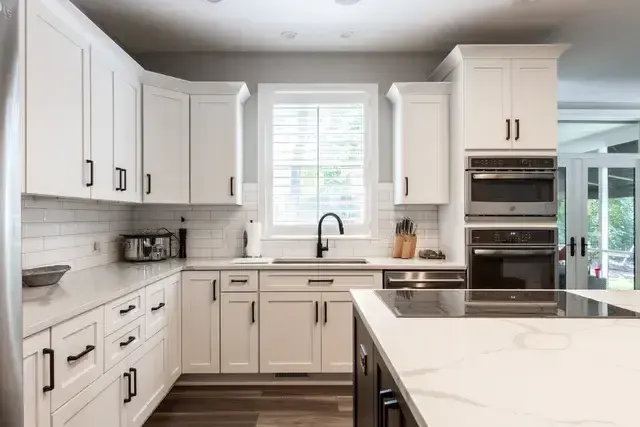
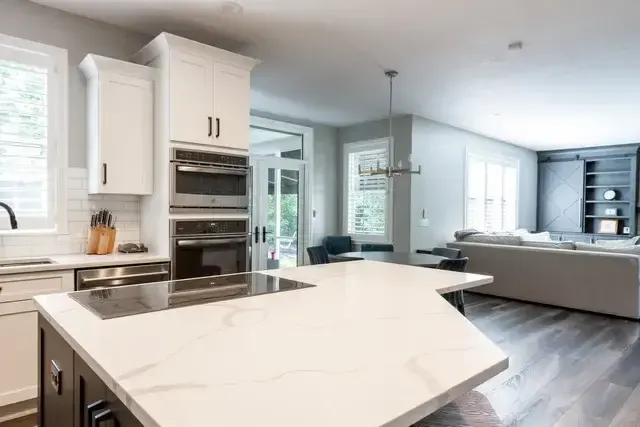
Photographs from real office window treatments jobs completed by our crew in New Palestine and surrounding areas.
What Office Window Treatments Includes
Every New Palestine job is documented item by item. Here is what the crew covers.
Site walk with facilities and, where the space is leased, with the tenant coordinator, so scope boundaries are settled before pricing
An opening schedule built with a number on every opening, then field verified rather than typed off the base building drawings
Elevations recorded by orientation, since the glare problem on the west face is not the problem on the north face
Workstation and monitor layout reviewed against each elevation, because screen glare is what generates the complaints
Openness factor selected per elevation and proven with a full-size sample hung on the actual glass before release
Conference and AV rooms identified early, as those want darkness on demand rather than daylight management
Control heights set inside the ADA section 308 reach ranges wherever the space requires compliance
Operating force checked against the five pound limit in ADA section 309.4 on every manual control specified
Motorization specified on the openings where no manual control can meet reach or force, rather than across a whole floor by default
Flame propagation test documentation obtained and placed in the submittal wherever the occupancy and the authority having jurisdiction call for it
Submittal package assembled with cut sheets, fabric and hardware samples, and a shade schedule tied to the opening numbers
Fabrication released only after approvals are back, since the factory clock starts at approval and not at order
Coupled tubes and aligned hembars drawn across a continuous run so a partly lowered wall reads as one line
Group addressing planned on motorized floors so one control drives a zone instead of five
Work sequenced suite by suite so no tenant loses a whole floor at once, with badges, freight elevator windows and staging agreed before the first crew day
Attic stock quantities agreed at contract, with dye lot movement between phases disclosed at the same time
Every promised date put on paper at release, with any slip from the factory passed to you the day we hear about it
Closeout documentation handed to facilities with fabric identification, hardware detail and the shade schedule for future reorders
What Office Window Treatments Cost in New Palestine
Office work prices per opening from a measured schedule, not per square foot and not per floor. The national ranges worth anchoring against are roughly $250 to $2,600 per window for custom-fabricated shades and roughly $300 to $1,500 per window installed for motorized product. Those are national category figures and they are not a bid for a building in New Palestine. Volume pulls the number down when a floor plate has a hundred openings of four repeating sizes. Fire test documentation, submittal cycles, phased after-hours access and specialty shapes all push it the other way. A Hancock County property with a dozen odd openings on a curved elevation is a different bid from a rectangular floor plate with the same count. New Palestine Window Treatments prices from the opening schedule with the control specification written into it.
How Office Window Treatments Differ by Product
Every product in this trade behaves differently in a room. Here is what that means for this work.
Solar screen roller shades: The workhorse of an office fit-out. One fabric decision drives daylight, glare and outward view together, and the openness number is where that decision actually gets made. Specify by elevation, because one fabric across four orientations satisfies nobody.
Dual roller assembly: A screen in front and a room darkening fabric behind on one bracket set. It's the right answer for a conference room that hosts a daylit meeting at ten and a projected presentation at two, and it costs less than fighting that battle with one fabric.
Coupled tubes across a run: Multiple shades driven as one continuous line across a long elevation, with hembars aligned. It's what stops a wall of glass looking ragged when the shades are halfway down, and it's a detail nobody notices until it's missing.
Low-voltage motorization: Hardwired motors on a building where nobody wants a battery program across two hundred openings. The header power is run by a licensed electrical contractor as part of trade coordination, and it wants to be in the base scope rather than added late.
Battery motorization for tenant retrofit: Where a lease or a finished wall rules out opening anything, battery motors get automation into an occupied suite. Budget the interval honestly: a floor of battery shades cycling daily is a recurring facilities task, not a one-time purchase.
ADA-compliant wall keypad: A fixed control mounted inside the section 308 reach ranges and operable well under the five pound force limit in 309.4. On a large shade where a chain would fail the force test, this is usually the cleanest route to a compliant control.
Scheduled and sensor-driven control: Shades that move on an astronomical timer or a facade sensor rather than on somebody remembering. It cuts the complaint volume more than any fabric choice does, because the shade is already down when the sun comes around.
Blackout with pocket and channels: A darkening fabric plus a light-blocking pocket at the header and channels at the jambs. Training rooms and AV rooms need the assembly, not just the fabric, because light comes around the edges of any inside mount.
Cassette and fascia treatments: An enclosure over the roll so the top of the opening reads as a finished line rather than a row of exposed tubes. On a building standard package this is usually what makes the shades look like part of the architecture.
Building standard shade package: One specification written once and applied across every suite: fabric, openness, hardware, color and mounting. It keeps the exterior appearance consistent from the street and makes reorders trivial two tenants later.
Office Window Treatments FAQ
Questions we hear most often from New Palestine homeowners considering office window treatments.
Office Window Treatments Across New Palestine
We measure and install in every one of these New Palestine neighborhoods. Each has its own page with the build eras, window conditions and mounting notes for that section.
- Office Window Treatments in The Original Town Plat
- Office Window Treatments in Cedar Creek and Cedar Cove
- Office Window Treatments in Bridgewood
- Office Window Treatments in Harting Farms
- Office Window Treatments in Willow Ridge
- Office Window Treatments in Centennial, Centennial Commons, Centennial Village and Centennial North
- Office Window Treatments in Boulder Creek
- Office Window Treatments in High Acres
- Office Window Treatments in Countryside and Homestead
- Office Window Treatments in Deer Run and the wildlife named streets
- Office Window Treatments in The Preserve
Other Window Treatment Services in New Palestine
New Palestine Window Treatments handles the full scope of window treatment work. Explore our other services below.
Faux Wood Blinds in New Palestine
Moisture proof slats for New Palestine wet rooms and wide openings
Learn more →Wood Blinds in New Palestine
Stained hardwood slats matched to real casing, not drywall returns
Learn more →Vertical Blinds in New Palestine
Vane coverage for the door walls in New Palestine's newest plans
Learn more →Schedule Your Free In-Home Measure in New Palestine
Reach Us Directly
Our team prioritizes scheduled measures and service calls, and books in-home measures during business hours.
Ready to Book Your Measure?
Call us to set up an in-home measure, or to ask about a treatment that has stopped working. We will talk it through on the phone first.