Custom Shutters for Odd-Shaped Windows in New Palestine
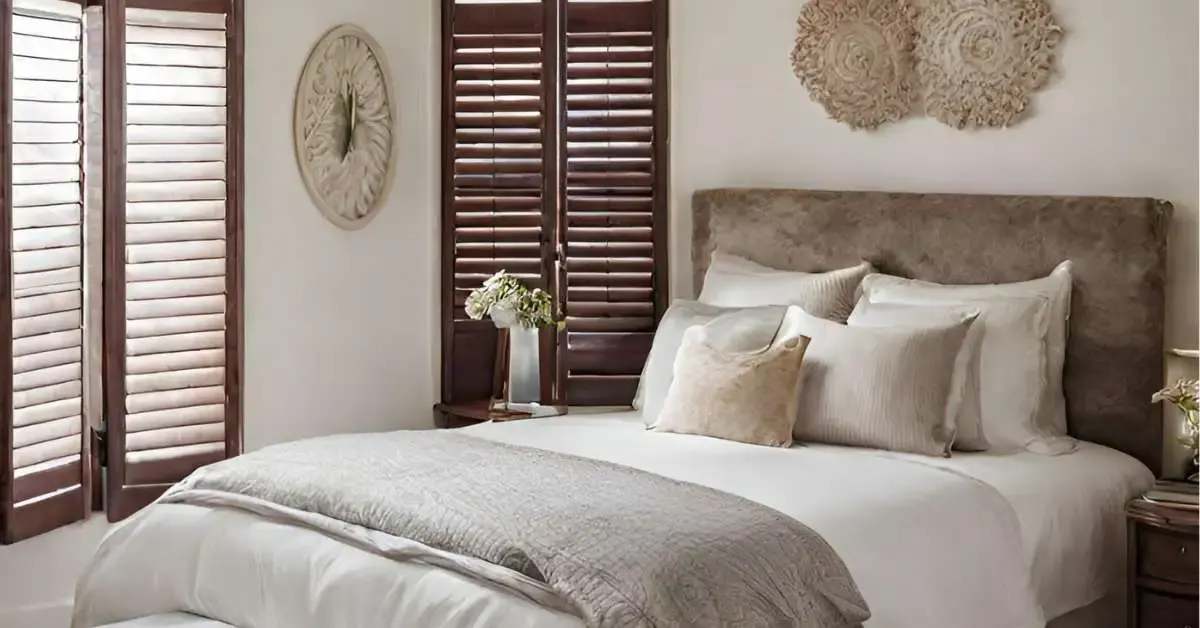
Somewhere in most New Palestine neighborhoods there's a house with a half-round window over the front door or a gable window with an angled top that nobody's ever quite known what to do with. Specialty shapes get skipped for years because the standard options at a big box store simply don't fit them.
The Specialty Shapes We're Talking About
New construction in and around New Palestine throws a specific kind of specialty shape at homeowners more than any other: the gable end window. Builders love a trapezoid or a triangle tucked up into a high peak for curb appeal, and it looks great from the street. It also happens to be a shape that no standard shutter or blind was ever built to fit.
Beyond the gable trapezoid, you'll see true arch tops over garage-adjacent windows, half-round transoms above a front entry, and occasionally a full octagon used as an accent somewhere on the front elevation. Every builder-grade spec sheet stops at rectangles, so these shapes get handed to the homeowner as-is, usually bare, with the assumption that whoever moves in will figure it out eventually.
None of these shapes are actually unusual in the trade, even if they feel that way to a first-time homeowner staring up at one. A shop that's been doing this a while has almost certainly built for that exact shape before, just maybe not on that exact house.
Why a Tape Measure Isn't Enough for a Curve
A rectangle can be measured with a tape and a level and that's genuinely the whole job. A curve can't, because a tape only gives you straight-line distances, and no straight line actually describes an arc. You can capture the overall width and height that way, but the shape of the curve itself has to be captured differently.
What actually happens on site is a template: the real curve or angle gets traced onto stiff paper or cardboard held right against the opening, sometimes with a flexible tool for a tight radius, so the shop is cutting to the true shape instead of a calculated guess. Very few arches in an actual house turn out to be a perfect mathematical curve. Small shifts in the framing over the years mean the real shape and the theoretical shape rarely match exactly.
This is also where a DIY attempt carries real risk. A rectangular window forgives being off by an eighth of an inch. A curved one doesn't, since a panel that doesn't match the actual arc simply won't seat flush, and there's no sending back a custom-cut shaped shutter once it's built.
Fixed Panels vs Operable Louvers on the Shaped Section
For curb appeal purposes, fixed panels do almost all the same visual work as operable ones. From the street, nobody can tell whether the louvers on that arch tilt or not. What they notice is whether the shape and the frame style match the rest of the house, and whether the color does too.
That makes fixed the common choice for a purely decorative shaped section, freeing up budget to make sure the finish and louver size match exactly rather than spending on tilt hardware that won't be visible from outside anyway. Operable still has its place, mainly on lower shapes like a half-round transom where someone standing at the door might actually want to adjust the light coming through.
Either way, matching matters more than mechanism for the finished look. A specialty shape shutter that's slightly off in color or louver width from its neighbors will stand out more than one that simply doesn't open.
Why Shutters Handle These Shapes Better Than Soft Treatments
Fabric and slat treatments both depend on a straight headrail or a rod to hang from, and a curved or angled opening doesn't give them one. That's the practical reason shutters dominate this category. A shutter is a rigid frame first, and the frame can be built to trace any shape the window actually is.
There are soft treatment workarounds for some shapes, mostly stationary fabric panels shirred onto a curved rod or mounted flat against the wall above the window, though they don't open or close. If the goal is actually controlling light through that section of glass, a shutter with a frame cut to the exact curve is usually the only option that does the job.
It also holds up better over time. A shaped fabric panel loses its form eventually, especially with humidity or direct sun on it, while a composite or wood shutter frame keeps its shape because it was built rigid from the start. That durability difference matters most on a window that sits in full sun most of the day.
Cost, Lead Time, and What to Expect With a Specialty Order
Standard shutters run roughly 175 to 800 dollars per window nationally. Specialty shapes generally land above that range, and the size of the increase depends on the shape's complexity, how high or hard to access it is, and whether you're going fixed or operable on the shaped section.
The way to keep the number reasonable without cutting corners on quality is mostly in that fixed versus operable decision. Choosing fixed for the shaped section and putting the operable budget into the rectangle underneath, if there is one, gets most of the visual payoff without paying for tilt function nobody will use.
Lead time runs longer than a standard order regardless of which option you pick, simply because of the template and the specialized build. Planning for that extra time, rather than being surprised by it, is the easiest way to keep a specialty shape project from feeling like it went over budget when really it just took the time it was always going to take.
Odd-shaped windows reward patience more than speed. Get a free in-home measure scheduled, let the actual curve get templated, and you'll have a firm answer on cost and options instead of a rough guess based on a photo.
Frequently Asked Questions
Will a specialty shape shutter match the ones on my other windows?
It can, as long as the frame style, the finish, and the louver size are specified to match. The shaped section usually becomes part of the same order as the rest of the room's shutters so the whole wall reads as one system rather than a mismatched addition.
What if my window is a trapezoid instead of a curve?
Angled shapes like trapezoids and triangles get the same templating treatment as curves. The angles just need to be measured precisely at each corner rather than traced along a curve, and the shop builds the frame to match those exact angles.
Is there a cheaper alternative to a custom shaped shutter?
A stationary fabric-covered panel cut to the shape is sometimes offered as a lower-cost option, though it won't open or close. For most specialty shapes, the honest answer is that there isn't a stock or off-the-shelf option, since the whole problem is that the shape isn't standard.
 Window Treatments for a New New Palestine Build: A Practical Guide
 How to Childproof the Blinds You Already Have in New Palestine
 Stain and Cord Mistakes That Damage New Palestine Window Treatments