Bay and Bow Window Shades: A New Palestine Homeowner's Guide
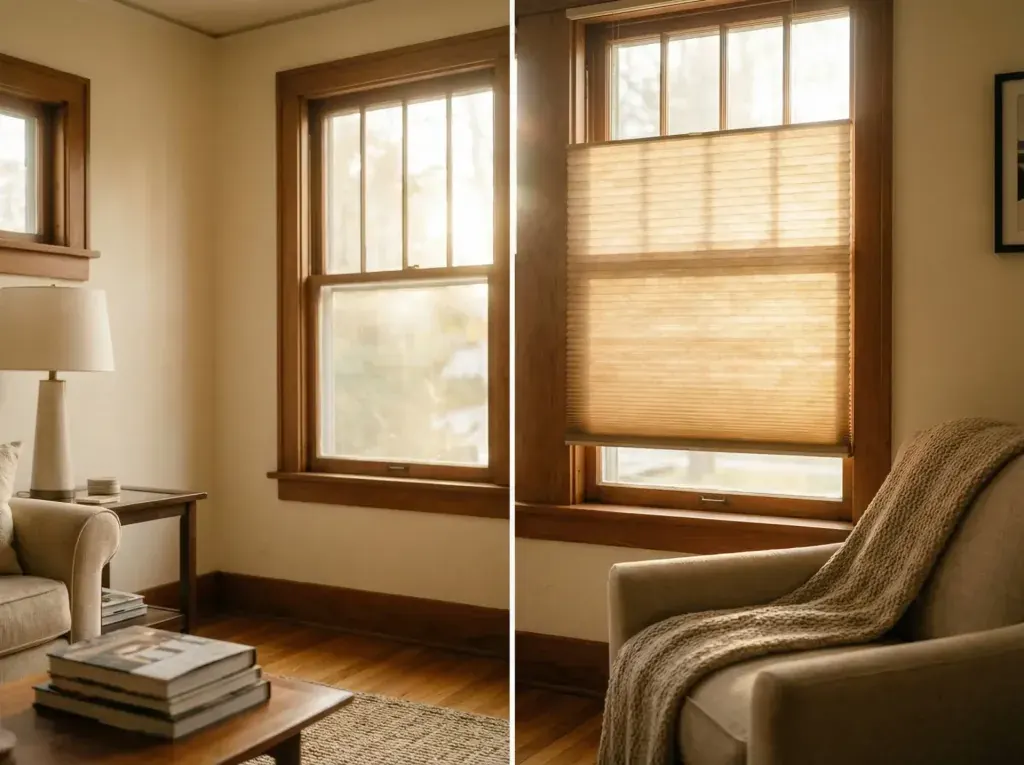
If you've got a bay or bow window and you're not sure where to even start on shades, you're not alone. It's one of the more common questions we field from homeowners across New Palestine and IN communities who've never dealt with an angled or curved window before.
Why Bay and Bow Windows Need a Different Approach
A bay or bow window treatment gets priced differently than a single window, and understanding why up front saves a lot of confusion once quotes start coming in. You're not buying one shade sized to a wide opening. You're buying two, three, or more shades that happen to share a wall, and each one gets priced and cut to its own exact size, then installed separately.
A standard bay window has two angled side units, usually at 30 or 45 degrees, flanking a center window that's often fixed. A bow window spreads a gentler curve across four to six panes instead. Either way, the per-window cost applies to every unit in the set, which is the main reason a bay window quote in New Palestine looks larger than a single-window quote even at the same fabric grade.
None of that means a bay window treatment has to blow up a budget. It means the budget needs to account for multiple units from the start, rather than getting anchored to a single-window price and feeling surprised later.
Matching Shade Styles to Each Angle of the Bay
Shade style matters for motorization on a bay window in New Palestine because not every headrail fits comfortably into a tight angled corner once a motor tube and a battery pack or wiring get added. Roller shades handle this well since the motor lives inside a compact tube that doesn't add much bulk to an already slim profile.
Cellular shades motorize well too, though the added rail depth needs to be checked against the same corner clearance issue that matters for manual cellular shades on a bay. Roman shades are the trickiest to motorize cleanly in a tight corner, since the fabric stack and the motor housing both compete for the same limited space.
On a bow window with gentler curves, there's usually more room to work with, so the style choice opens up. On a sharp-angle bay, sticking to roller or cellular shades in a slim housing keeps motorization straightforward instead of fighting the geometry of the corner.
Choosing How to Operate Multiple Shades at Once
Mounting three separate manual shades on a bay window and expecting them to stay in sync sets you up for a small daily annoyance. Someone raises one side in the morning for light, forgets the other, and by afternoon the bay looks lopsided. It's minor, but it's the kind of thing that adds up over years of living with a window treatment.
Motorized shades fix this by letting you group the units so they move together on one command, while still giving you the option to run them independently when the sun hits one side of the bay harder than the other. That flexibility is usually worth more on a bay window than on a single flat window, simply because a bay window faces more than one direction at once.
The mistake to avoid on the safety side is putting standard corded shades within easy reach of a window seat in a New Palestine home where kids climb or nap. A window seat puts small hands right at cord height. Cordless or motorized lift removes that risk entirely instead of just managing it.
What Bay and Bow Window Shades Typically Cost
Because a bay or bow treatment is really several shades bought and installed as a set, pricing it like one window will throw off your budget fast. As a national general range, not a quote for any specific job, cellular or roller shades in a mid-grade fabric often run somewhere between $150 and $400 per window depending on size and material, and that per-window range applies to each unit in your bay, not to the bay as a whole.
Motorization adds cost per unit too, commonly another $150 to $300 per shade within that same general range, with battery-powered lifts usually landing lower and hardwired lifts landing higher. A custom valance or a mitered cornice that wraps the angles adds labor on top of that, since it has to be built for your window rather than pulled off a shelf.
The only way to get a real number instead of a per-window range is a free in-home measure, where every unit in your bay gets priced individually. Your specific angle changes the math, and so does the fabric you choose. Window seat depth plays a role too.
Whether motorization makes sense for all of your bay window's units or just the hardest one to reach is easier to decide once you can see the actual layout. A free in-home measure is a good next step for working that out.
Getting an Accurate Measurement on a Multi-Angle Window
Good design starts with good numbers, and a bay window will punish you for skipping this step. Measure each opening on its own. Homes built decades ago in New Palestine rarely have three window openings that are perfectly identical, even when the trim was installed at the same time. Settling and hand-framing add up to real differences over the years.
Take width measurements at more than one height in each opening, and take height measurements on both the left and right side of the frame. If a shade needs to fit flush for the design to read correctly, use the smallest number you find so nothing binds or gaps once it's mounted.
Depth is a design constraint too, not just a fit constraint. A deep inside-mount cellular shade can sit almost flush with the wall, while a shallow roller cassette might project further into the room. On a bay window, where sightlines matter from several angles, that difference is more visible than it would be on a flat single window.
Frequently Asked Questions
Do all three windows in a bay need to match?
They don't have to be identical, but keeping the fabric and the mounting style the same across all the units is what makes the bay read as one treatment instead of three separate ones. The center window can be a wider version of the same shade rather than a completely different product.
Can I use the same shade style on a bow window as a bay window?
Usually, yes, and bow windows actually give you more flexibility since the angles between units are gentler than a standard 30 or 45 degree bay. Roller and cellular shades work well on both, while bulkier styles like roman shades have an easier time clearing the wider curves of a bow than the tighter corners of a bay.
How long does it take to get shades for a bay window once they're ordered?
It varies by product and fabric, since a bay or bow order involves multiple custom-cut units instead of one. Whoever measures your window can walk you through the timeline for the specific products you're considering.
 Window Treatments for a New New Palestine Build: A Practical Guide
 How to Childproof the Blinds You Already Have in New Palestine
 Custom Shutters for Odd-Shaped Windows in New Palestine