What Plantation Shutters Cost in New Palestine and Why They Last
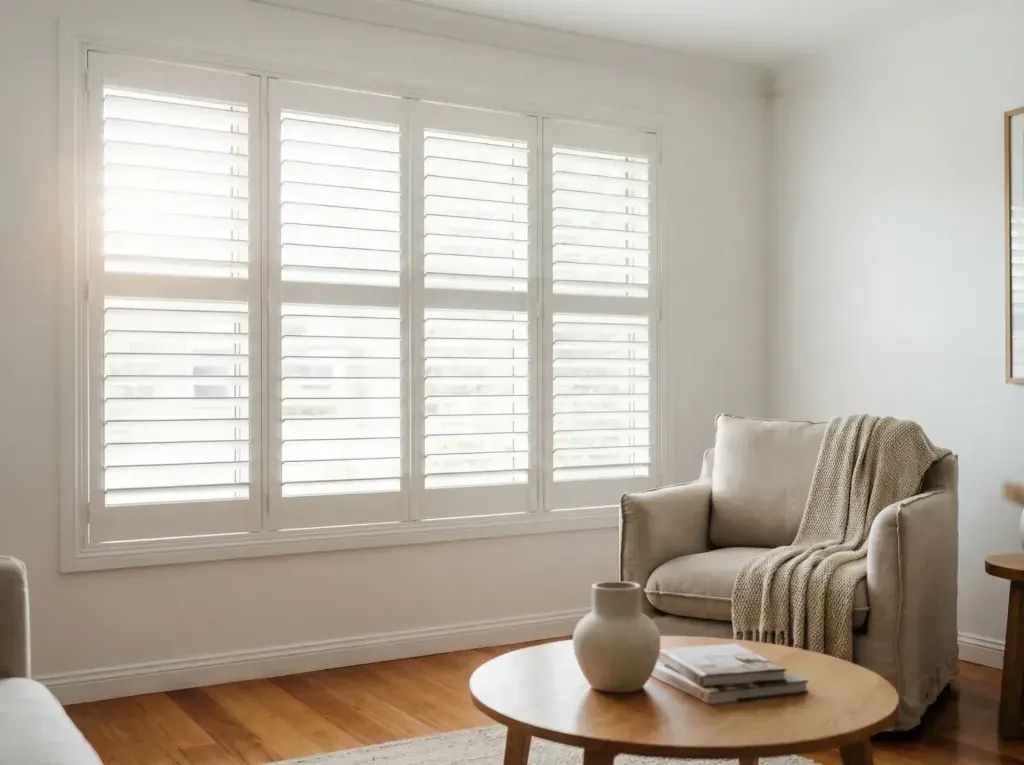
A shutter order has a lot of specification packed into it, and most of it cannot be changed once the panels are built. Material, louver width, frame style, panel layout, and divider rail height all need to be settled and written down before anyone signs. This is the list we walk through with New Palestine homeowners at the measure, and it works just as well as a checklist before you approve anyone else's quote.
Measuring the Opening Before Anything Else
A shutter quote cannot be accurate until someone measures the opening properly, and that measure is more involved than a tape across the width. Installers take width in three spots and height in three spots, then check both diagonals corner to corner. A difference of more than about a quarter inch between those diagonals means the opening is out of square, and that is true in a large share of New Palestine homes regardless of age.
It matters for pricing because a shutter panel is a built rectangle, and a rectangle does not bend to fit a crooked hole. Skipping this step is how a quote ends up wrong, either because the frame gets underspecified or because someone tries to force a direct mount panel into an opening that needed a real frame. Getting the measurement right the first time is cheaper than a remake.
Newer construction is not exempt. Drywall corners build up thickness unevenly, and that throws a window out of square just as reliably as decades of settling does in an older house. Either way, the frame decision downstream depends on what the diagonals actually show.
Hardwood or Composite
Decide material room by room in your New Palestine home and get it written down that way rather than leaving it as one blanket choice for the house. Composite belongs in bathrooms and over kitchen sinks, since it does not move with humidity the way hardwood can. Hardwood, usually basswood, is worth the extra cost where you need to match a stain or paint color, or where a wide opening benefits from the broader panel hardwood can carry.
Ask what happens on a wide composite panel specifically. It needs a hidden aluminum reinforcement inside the rail to stay flat on its hinges, and that should be part of the spec rather than an assumption. Confirm the color options match what you actually need, since composite only comes in a short list of whites and neutrals.
If the house is being finished in stages, get the finish name and code written on the order for both hardwood and composite, so a later room has a real chance of matching what is already hanging.
What Shutters Cost
The most expensive mistake on a shutter order is assuming two quotes for the same New Palestine house describe the same product. Custom coverings measured and installed run roughly $250 to $2,600 a window based on national figures, and shutters sit at the top of that range because of the material and labor involved, not padding. A quote that looks low next to another is usually missing a spec, not offering a better deal.
Ask for the configuration in writing: material, louver width, frame style, panel count, and divider rail placement for each opening. Two honest quotes can differ by a wide margin because one is composite with an L frame and the other is stained hardwood with a deco frame, and neither number means anything without that detail attached.
IN issues no license for this trade, so do not judge a quote by a license number that does not exist here. What matters is a written contract with a firm price and scope, which the Indiana Home Improvement Contract Act requires for jobs over one hundred fifty dollars. Skipping that step, not the price itself, is the actual mistake worth avoiding.
Shutters change a room more than any fabric does, so the specification deserves a walk through the house rather than one blanket decision. New Palestine Window Treatments does that walk with you in New Palestine and writes down every configuration, room by room. Call (317) 999-5154 to set up a measure.
Frame Styles and Panel Layout
Bedrooms are the strongest case for a divider rail, since closing the bottom section while the top stays open gives privacy from the street without living in the dark all day. Shutters are not a blackout product. Closed louvers still pass light around the edges and between the slats, so a light sleeper in a bright bedroom often ends up layering a drapery panel behind or in front of the shutters.
Bathrooms and kitchens want composite paired with a layout that respects the obstacles in the room. Cafe style shutters, which cover only the lower half of the opening, handle a countertop or a faucet that would otherwise block a full panel from swinging open. Check the swing clearance at the measure with the faucet raised to its tallest position.
Tall stairwell openings want a divider rail whether the homeowner likes the visual line or not, since the stiles need the stiffening on a panel that size. Lining the rail up with a transom or the head of a nearby door makes it look intentional instead of arbitrary.
Louver Width and What It Does to the Room
Louver width is the spec people underestimate most. Common sizes run 2 1/2 inch, 3 1/2 inch, 4 1/2 inch, and on very tall openings, 5 1/2 inch. The number is less a style label than a count of how many horizontal lines end up crossing your glass.
A 2 1/2 inch louver on a tall window can stack twenty or more slats into a single panel, cutting across the view once open. Move up to 4 1/2 inch and that same opening might carry ten. Wider louvers leave more open glass and read heavier and more architectural. Narrower louvers look finer and more traditional, suiting a small window where a big louver would look out of scale.
There is a mechanical side too. A wider louver swings through a bigger arc as it tilts, needing more depth inside the frame before it clears the glass. Put a 4 1/2 inch louver on a shallow opening and it will hit. The fix is a narrower louver or a deeper frame, caught at the measure rather than on install day in a New Palestine kitchen.
Frequently Asked Questions
Can I get shutters without a divider rail?
On a short panel, yes. On a tall panel it's a bad idea. The divider rail stiffens the stiles and keeps the tilt mechanism working smoothly over years of daily use. Without it, a tall panel gets loose and the louvers stop holding their angle. There's also a practical loss: a divider rail is what lets you close the bottom for privacy while the top stays open for daylight, and people who live with that rarely want to give it up.
Are composite shutters lower quality than hardwood?
No, they're different. Composite doesn't move with humidity, which makes it the better choice in a bathroom or over a kitchen sink. It holds up anywhere a room swings between wet and dry. The trade is weight and color: composite panels are heavier, so wide ones need a hidden aluminum reinforcement in the rail to stay flat, and the color range is a short list of whites and neutrals. Hardwood is the answer when you need a stain match or a very wide panel.
Can shutters be installed if my window has a deep sill or a countertop below it?
Usually, but the layout has to change. Hinged panels need clearance to swing into the room, and a countertop, a deep sill, a radiator cover, or a chair pushed against the wall will all block them. The common answers are a cafe style shutter that covers only the lower part of the opening, a bypass track where panels slide past each other, an outside mount frame that sits proud of the obstruction, or a different covering on that one window. This gets sorted at the measure, so point out the obstruction then.
 Window Treatments for a New New Palestine Build: A Practical Guide
 How to Childproof the Blinds You Already Have in New Palestine
 Custom Shutters for Odd-Shaped Windows in New Palestine