Measuring for Zebra Shades: What New Palestine Homeowners Should Know
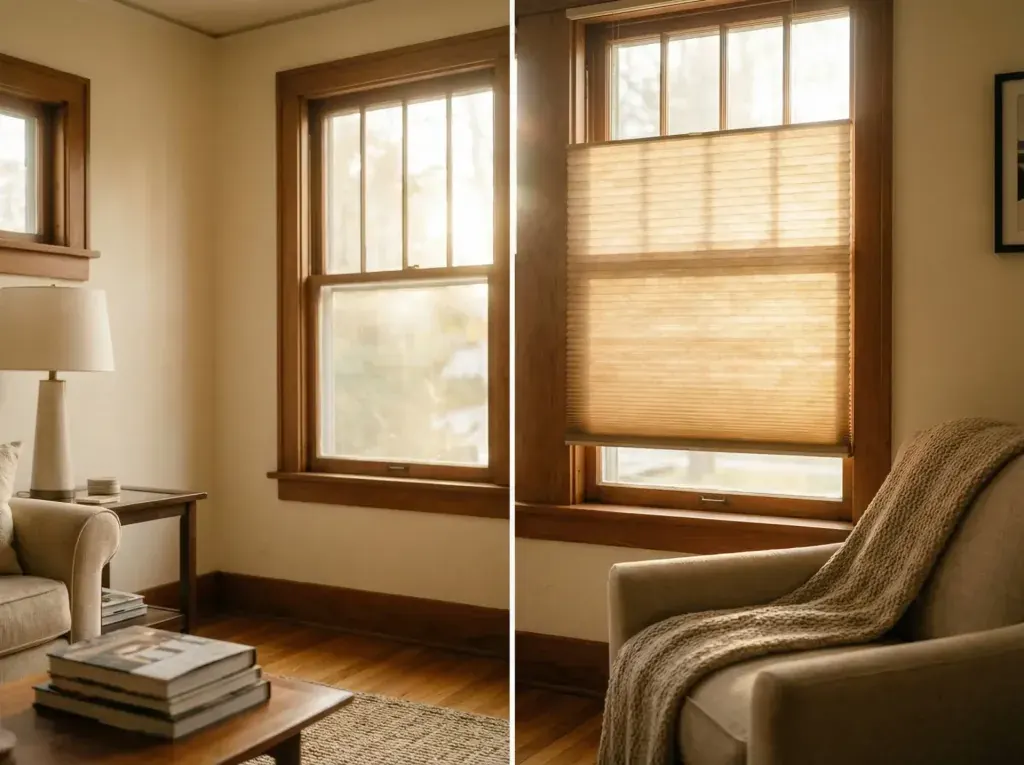
Zebra shades land on nearly every New Palestine shopping list right now, usually because somebody saw one in a photo and liked the horizontal bands. They're a genuinely good product, and they're also the one we end up explaining most, because what they do at two in the afternoon and what they do at nine at night are not the same thing. Here is how the fabric actually works, and what the measure has to catch before anybody orders anything.
How Zebra Shades Work
Before pricing a zebra shade it helps to know what you're actually buying, because the mechanism is what separates this product from a plain roller, and it's also where part of the cost lives. The shade is a single loop of fabric, alternating a solid band and a sheer band, wrapped around one roller tube. As the tube turns, the front layer of the loop slides past the back layer. Align the sheer sections and light and view pass through; align the solid sections and they don't.
Because one tube and one piece of fabric do a job that would otherwise take two separate shades layered on double brackets, a zebra shade is often cheaper to buy and mount than building the same view-then-privacy function out of a sheer roller plus a solid roller. The tradeoff is precision: the bands have to be sewn and wound accurately, and a wider or taller shade puts more strain on the tube and the clutch holding it in position. That's the part of the mechanism a fabric swatch never shows you, and it's exactly what a good measure checks for in a New Palestine home.
Measuring, Mounting and Care
Two shades that look the same on paper can mount very differently depending on your opening, so measuring is where a good installer earns their fee. A cassette style headrail needs roughly two and a half to three inches of flat depth behind the trim for a flush inside mount; short of that, you're choosing between a bracket only mount, which leaves the roll visible, or an outside mount, which covers more of the wall but solves the depth problem entirely. Checking the opening for square matters just as much as the raw width and height numbers.
An outside mount sidesteps both the depth and the square issues at the cost of covering more wall around the window. Whichever mount a New Palestine homeowner chooses, the shade still needs simple care to last: a soft brush vacuum on low suction moving across the bands, not up and down, and a barely damp cloth with a little mild soap for spots, with the shade left to dry fully in the down position before it's rolled back up.
Cost, Lift Choices and What Drives the Price
Cheap tube and clutch hardware is where a bargain zebra shade actually fails, usually within the first two years, after the return window has closed. A clutch that starts slipping means the shade won't hold position and slowly creeps down under its own weight; a tube that flexes under a wide shade shows up as sagging fabric in the middle. None of that is visible on a showroom sample, which is why price alone is a poor way to shop this category.
National ranges still give you a place to start: stock shades run roughly $60 to $600 a window, and custom shades measured and installed nationally run roughly $250 to $2,600 a window. Lift adds its own spread on top of that. A cord loop is cheapest but needs a tensioner fastened to the wall every time. Cordless and motorized both cost more. Cordless is the right call around kids or pets, built to the ANSI/WCMA A100.1-2022 standard, while motorized costs the most upfront, though battery motors nationally run roughly $100 to $300 a window less than hardwired versions.
Knowing that a zebra shade glows at night, rather than finding it out after installation, changes how you shop for one. Ask about layering before you order, not after. New Palestine Window Treatments walks every New Palestine homeowner through what a room will actually look like after dark before anything is fabricated. Call (317) 999-5154 to talk through your windows.
Where Zebra Shades Fit Best Room by Room
Work through a house one room at a time and the fit sorts itself out fast. In a living room or family room, mount the shade high and wide if the trim allows, keep the fabric light to medium in tone, and let the bands kill afternoon glare off a television without losing the view the rest of the day. A kitchen is a good candidate too, except directly behind a cooktop, where grease makes a sheer band a bad idea; a faux wood blind or vinyl roller wipes down easier there.
A bathroom is a maybe. Humidity itself isn't the issue; nighttime privacy is, since a zebra's sheer half always glows a little after dark. A small, high window or one facing a fence is fine as is; one facing a neighbor at eye level does better with a room darkening roller instead. Bedrooms carry the same warning: closed, a zebra dims the room and blocks the view in, but it still glows, so pair it with a drapery panel on a decorative rod if the room needs to go properly dark at night. A New Palestine home office with glare on a monitor is one of the strongest matches in the house.
Privacy and Light Control: What to Expect
This is the part people find out the hard way, so it deserves to be said plainly. In the open position, a zebra shade behaves like a sheer curtain: daylight outside is stronger than light inside, so you see out and nobody sees in. After dark that relationship flips, and anyone outside can see straight into a lit room.
Closed, a zebra shade is a lot better, but it's still not blackout. The sheer band is sheer by definition, so a fully closed shade glows at night and shows movement as a soft shape rather than hiding it completely. There's no true blackout zebra shade, whatever a sales sheet claims. A bedroom that needs real darkness wants a blackout roller with side channels, a lined drapery panel layered over the zebra, or both together.
Frequently Asked Questions
How do I clean a zebra shade without damaging it?
Vacuum with a soft brush attachment on low suction, moving across the bands rather than up and down, since dust collects on the top edge of every horizontal band. For a spot, use a barely damp cloth with a drop of mild dish soap, blot rather than rub, then leave the shade fully down until it dries. Never soak the fabric or put it in a machine, and keep solvents and bleach well away from it. If a sheer starts pulling loose at a seam, stop and call before it runs.
Are zebra shades safe around small children?
Choose a cordless lift or a motor and the hazard mostly goes away. Ask specifically for cordless product built to ANSI/WCMA A100.1-2022, which is the product safety standard that covers this. If you keep a continuous cord loop for cost or size reasons, its tensioner has to be fastened to the wall or window frame at install and left there. A loose loop hanging free is the situation that standard exists to prevent.
Will two zebra shades on the same wall line up?
Only if you plan for it. The band positions depend on how far the fabric has unrolled, so two shades of different finished heights, or two stopped at slightly different points, will show bands that do not match across the wall. On a run of windows we specify matching finished heights where the openings allow it and set the shades together at install. It is a small detail that decides whether the wall looks intentional or slightly off.
 Window Treatments for a New New Palestine Build: A Practical Guide
 How to Childproof the Blinds You Already Have in New Palestine
 Custom Shutters for Odd-Shaped Windows in New Palestine